Welcome To Hacker News

Welcome to Hacker News. Hacker News is a bit different from other community sites, so we'd appreciate it if you'd take a minute to read the site guidelines

Cyber World News

delivers the latest breaking news and information on the latest top stories, weather, business, entertainment, politics, and more

Hacker News

This is a monthly meetup for entrepreneurs, hackers, techies, or anyone else who reads or likes the topics ... Welcome to the Hacker News Seattle Meetup.

Difrent Community

Welcome to Hacker News. Hacker News is a bit different from other community sites, so we'd appreciate it if you'd take a minute to read the site guidelines.

This is Social Site

Hacker News is a social news website that caters to programmers and entrepreneurs, delivering content related to computer science and entrepreneurship.

Sunday, June 21, 2015

275k+ Sony files: WikiLeaks publishes massive new cache of hacked docs

Whistleblowing website WikiLeaks has released 276,394 new documents stolen from Sony Pictures in November by an unidentified hacker. It adds to 30,000 documents and 173,132 emails released earlier in April.
The new documents are available since Tuesday through the WikiLeaks search service. No public statement from the website came with the publication, but it claimed on Twitter that the dump contains some sensitive legal documents tied to an alleged bribery investigation.

RELEASE: Sony Files Part 2 -- 276,394 more docs Search: https://wikileaks.org/sony/docs/  Browse: https://wikileaks.org/sony/docs/filelist/ 
The release of stolen data came after Sony Pictures, a subsidiary of the Japan-based Sony conglomerate, earlier condemned WikiLeaks for releasing hacked data. WikiLeaks said the documents belong to the public domain because they are revealing the inner workings of a powerful company with ties to the US government and military.

WikiLeaks’ move is being seen by observers as having some justification. For instance, the earlier leaks showed that in an announcement of a biopic of NSA whistleblower Edward Snowden, Sony replaced phrases "US government’s illegal spying operations" and "misuse of power" with more timid "US government’s intelligence gathering" and "actions" respectively, indicating that the company would not risk criticizing the intelligence agency.
The US also wanted Sony's help in countering the terrorist group Islamic State and Russia online.

The White House blamed North Korea for staging the attack on Sony. Some IT experts doubted Pyongyang's role, saying the hack was likely an inside job. North Korea denied any involvement.
Wikileaks publie 276.000 nouveaux documents de Sony http://trib.al/Fdsxk6i  See: https://wikileaks.org/sony/
The North Korean connection emerged because the hackers threatened the release of stolen data if Sony released the comedy “The Interview,” which depicts a fictional CIA plot to kill North Korean leader Kim Jong-un.

The previous cache of documents exposed some scandalous details of Sony operations that left several top officials red-faced. Part of it was due to the insulting way the executives discussed actors and other people from the entertainment industry. Then-chairperson Amy Pascal resigned after the leak showed her sending racially-loaded jokes about President Barack Obama over email.
Other revelations were arguably even more embarrassing. CEO Michael Lynton, according to the documents, maneuvered to have his daughter Maise admitted to the prestigious Ivy League Brown University.
In a more sinister development, some private data of people involved in the entertainment industry was made public. For, example the salaries of more than 6,000 Sony Pictures employees were leaked online.

Wednesday, June 17, 2015

Super-private social network launched to take on Facebook with support of Anonymous ?

A new social network, backed by Anonymous, hopes to take on Facebook and the other social media giants with a commitment to privacy, security and transparency about how posts are promoted.
The site, Minds.com, has the same basic options as any other social network: users send updates to their followers, who can comment or promote posts that they read. But unlike its competitors it doesn’t aim to make money from gathering data — instead, it encrypts all messages, so that they can’t be read by advertisers or by governments.
The app’s other big differentiating feature from other networks is that it rewards people for interacting with posts, by voting, commenting or uploading. Users are given points that can then be exchanged for views, meaning that the posts of active members will be more promoted by the network.
READ MORE
FACEBOOK SIGNS USERS UP TO PRIVACY POLICY THAT ALLOWS IT TO TRACK YOU EVERYWHERE ON THE INTERNET
FACEBOOK IS TRAMPLING ON EUROPEAN PRIVACY LAWS
FACEBOOK MANIPULATED USERS' MOODS IN SECRET EXPERIMENT
The site describes that mechanism as a “network that rewards you with reach”. As such, it is more straightforward than the Facebook algorithm — which the company little discusses and seems to work on a complicated mix of engagement, clicks and now the time spent looking at certain posts.
The site has been officially launched with desktop and mobile apps. But the group behind the project has made it entirely open source, so that anyone can contribute to the design and upkeep of the network.
An Anonymous-affiliated page with over a million followers, ‘ART of Revolution’, put out a call to support the site. “Let us collaborate to help build minds.com and other open-source, encrypted networks to co-create a top site of the people, by the people and for the people”, the message read.

Friday, June 5, 2015

Photo appears to show Anonymous member killed in Israel

A member of the Anonymous hacker collective appears to have been killed in the ongoing violence in Israel.
In a photograph by the Israel-based photographer Abed Qusini, proteser Tayeb Abu Shehada, 22, can be seen throwing a rock at Israeli soldiers while sporting a Guy Fawkes mask, the unofficial symbol for Anonymous.
Shortly after the first photo was taken, Shehada (the name is also spelled Shehadah in different accounts) was killed in the West Bank town of Huwara, near Nablus,maannews and humanizepalestine reported. The second photograph of the bloodied mask was taken by photographer Ahmad Talat Hasan, who also posted it on Facebook with Shehada's name.
A third photo (which is extremely graphic) taken by an unknown photographer allegedly shows Shehada with his mask off after being shot. It was tweeted by @redhackeditor.
Qusini's photograph of Shehada circulated around Twitter on Saturday, with the help of London-based doctoral student Ramy Abdu.
Tayyeb Shehadah throws stones at Israeli soldiers before he was shot dead under his eye as you can see in the mask pic.twitter.com/zdE0PF3QEU
— Dr. Ramy Abdu (@RamAbdu) July 25, 2014
Abdu stated in an email interview with the Daily Dot on Saturday that the photograph is authentic.
“Israeli forces repeatedly use an excessive force, including unlawful lethal force, against Palestinians who did not pose an imminent lethal threat,” Abdu added. “Israel’s violations against the Palestinians has never stopped for the past 66 years. Israel commits different crimes and violations without being bothered. This is not the first time, won't be the last time, as long as the international community provides the immunity and give Israel the feeling that it is a above law country.”
The Daily Dot has reached out to Qusini and Hasan for further confirmation regarding the authenticity of the photos. Numerous other messages have also been sent to Reuters, whom Qusini claims to be employed by on LinkedIn.
The news of Shehada’s death has had a chilling effect on the Anonymous community. On cyberguerrilla.org, a song was posted and dedicated to his memory.
“[Shehada] wasn’t only wearing a mask, he was Legion. 1 of us,” blogger Doemela states. “Today Israel murdered a Anonymous. To them We shall join their struggle: nor shall We deprive them of the fruit of anything of their works, lower your weapons humbly for them, with mercy, peace and blessings be upon them who seek love.”
On 4chan, where Anonymous was founded in 2003, users paid tribute by repeatedly posting, “His name was Tayyeb Abu Shehada,” which was inspired by a scene from Fight Club featuring members of Project Mayhem repeating the name of one of their fallen.
Since the conflict in Gaza between Hamas and Israel began 19 days ago, more than 1,000 people—most of which are Palestinian civilians—have been killed, the Los Angeles Times and the AFP reported. The conflict began in June, after three Israeli studentswere kidnapped and ultimately found dead. Blame was unofficially laid on Hamas, a “Palestinian Islamist political organization and militant group that has waged war on Israel since its 1987 founding,” Vox reported. Tension rose steadily since then, and has resulted in an all-out war between Hamas and Israel. Thousands of missiles have been shot from either side, and on July 18, the Israeli military invaded Gaza.
temporary humanitarian cease fire was being discussed between both sides Saturday, but the length of it is uncertain.
Update: Hasan responded via Facebook, confirming his photo is real: 
I am glad that my photos are spared everywhere to show the truth. Well, they are real and each incident I captured happened in front of my eyes. A lot of Israeli settlers pass through this street and use in order to go to their settlements which seem so close to that street. One of these settlements is Yahatsar; it is built up on a Palestinian land refers to Palestinians citizens. A demonstrations aimed to condemned and act about the anger of the war on Gaza was set out from the mosque and it was held on the main street while a car for one of the settlers enters the street; this car included the settlers and his wife who fired four bullets on the demonstration and four people were injured and taken to the hospital. One of those injured dead after half an hour only. As a result, Clashes and confrontations between the Palestinians and Israeli soldiers started in the same town; at that point one of the Israeli soldiers fired bullets on the Palestinians guy who wears the white mask on his face; the bullets comes to his head exactly above the eyelid on the right eye and he died directly.

Thursday, June 4, 2015

Catastrophic Collapse of Saiga Antelope Leaves 120,000 Dead in a Month

Kazakhstan – An aerial survey conducted as part of a national monitoring program earlier this year estimated that the saiga antelope population numbered approximately 250,000 animals prior to this mass die-off, which has therefore halved the total population in about one month.
Preliminary analysis indicates that a combination of environmental and biological factors is contributing to this catastrophic event, which has seen four large birthing herds of the critically endangered Saiga antelope wiped out since mid-May this year. Primarily mothers and calves are among the carcasses; not a single animal has survived in the affected herds.

According to information received from the members of the CMS expert mission, it is becoming clear that two secondary opportunistic pathogens, specifically Pasteurella and Clostridia, are contributing to the rapid and wide-spread die-off. However, the hunt for the fundamental drivers behind the mass mortality continues since these bacteria are only lethal to an animal if its immune system is already weakened.
At the request of Kazakhstan, the Secretariat of the Convention on the Conservation of Migratory Species of Wild Animals (CMS) dispatched an emergency mission last week with experts from the Royal Veterinary College in the United Kingdom and the Food and Agriculture Organization to assist on the ground with post-mortem examination, analysis and to contribute to a working group.
The animals die within hours of showing symptoms, which include depression, diarrhea and frothing at the mouth.
“They get into respiratory problems, they can’t breathe easily. They stop eating and are extremely depressed; the mothers die and then the calves are very distressed and then they die maybe one or two days later,” said Richard Kock from the Royal Veterinary College in London.
viewimage
While mass mortality events are not unusual for the saiga antelope, they typically affect far smaller numbers of animals, on the order of about 10,000 saigas. The magnitude of this event, therefore, is unprecedented, given the population’s large size.
Conservationists have made great progress with Saiga in recent years, due to international efforts to reduce poaching and monitor their populations. This die-off is a severe setback to the conservation effort because it has wiped out four of the six calving herds in the largest remaining – and best protected – saiga antelope population, in central Kazakhstan.
Steffen Zuther, head of the Association for the Conservation of Biodiversity in Kazakhstan (ACBK), was monitoring calving in one of the herds containing thousands of affected animals.
“Over two days  [in the herd I was studying] 80% of the calving population died,” he told the BBC.
The whole herd then died within two weeks.

Monday, June 1, 2015

Mystery Human Species, Facts Emerge From Denisovan Genome


In November 2013, researchers discovered an entirely new species of hominin currently strange to modern science. The genome analysis of a finger bone and two teeth found in a Siberian cave suggested there was interbreeding between modern humans, Neanderthals, Denisovans and an unknown archaic population.
The genome from a Neanderthal was also analyzed from the excavation, and the results suggested that interbreeding was common in human evolution and occurred among members of multiple ancient human-like groups in Europe and Asia more than 30,000 years ago. After our direct ancestors expanded out of Africa, they interbred with both Neanderthals and Denisovans contributing to the genetic diversity of many people today.
In July 2014, scientists found that Tibetans were able to adapt to high altitudes thanks to EPAS1, a gene they acquired when their ancestors bred with Denisovans – a mysterious group of prehistoric hominins that went extinct around 45,000 years ago.
In February 2015, researchers in Germany identified a gene that is only present in humans, making human brains three times bigger and complex than other species. The gene, called ARHGAP11B, is found in modern-day humans and our ancient relatives, Neanderthals and Denisovans, but not in chimpanzees.
Scientists believe that ARHGAP11B played a key role in the evolutionary expansion of the human neocortex and that during evolution human genome must have changed in order to trigger such a massive brain growth – from 30 cubic inches in volume around 3.8 million ago to 85 cubic inches when Neanderthals and Denisovans arrived.

Thursday, July 10, 2014

Facebook Takes Down Bitcoin Stealing Botnet that Infected 250,000 Computers


Once again Facebook is on The Hacker News! This time not for any scam or surveillance, but for a different reason. 

The social networking giant has managed to take down a Greek botnet that used Facebook to spread malware and infected 250,000 computers to mine crypto-currencies, steal bitcoins, email passwords and banking details.

Facebook is always one of the favourite weapon of cyber criminals, cyber thieves and scammers due to its popularity among other social media platforms. This social networking platform, with more than one billion active users, provides special opportunities for people to connect and share information, as well as also serves a great platform for malware developers and scammers.

The botnet, dubbed as Lecpetex, was around from December 2013 to last month and compromised around 50,000 Facebook accounts at its peak, under which users would receive spam Facebook messages that would typically like "lol" with a zip archive attachment.

Once the attachment is opened, it would execute an embedded Java archive file that would download Lecpetex main module and install a program to begin Litecoin mining secretly on the infected computer, and at the same time, other malware sent out from the botnet would steal bitcoins, email passwords and internet banking details.

Moreover, the module would download and run the Facebook spamming module that would hijack user’s account by stealing cookies from their browser in an effort to gain access to the victim's Facebook friend list so that it could further send out more spam messages to each friend with a zip file containing malware.

The Lecpetex botnet infect computers with family of different malware, including the DarkComet remote access trojan, through simple social engineering techniques, and the operators behind it were constantly modifying it in order to evade detection, both by Facebook's attachment scanning software as well as anti-virus software.

Security researchers at Menlo Park said the 31 and 27 year-old botnet creators delivered over 20 distinct spam campaigns, affecting users in Greece, Poland, Norway, India, Portugal, and the US. Not even themalware targeted Facebook alone, the malware was also delivered through torrent files containing pirated content like movies, games and MP3s to trick unwitting downloaders, but this was not observed by Facebook bods.

"On April 30, 2014, we escalated the Lecpetex case to the Cybercrime Subdivision of the Greek Police, and the agency immediately showed strong interest in the case," Facebook engineers wrote in anunauthored post.

After five months of examination, irritated botnet creators began leaving messages for Facebook engineers from their command and control servers saying that:
"Hello people.. :) but am not the f***ing zeus bot/skynet bot or whatever piece of sh*t.. no fraud here.. only a bit of mining. Stop breaking my ballz.."
They also changed their crypto keys to the phrase 'IdontLikeLecpetexName'.

But Facebook didn’t stop its investigation and continued to target botnet with new countermeasures and automated tools in order to extract more information from the botnet to trace its creators, and finally theGreek Police arrested two hackers last week, a 31-year-old and a 27-year-old who were both informatics students.
"According to the Greek Police, the authors were in the process of establishing a Bitcoin 'mixing' service to help launder stolen Bitcoins at the time of their arrest," said Facebook. “Ultimately, remediating a threat like Lecpetex requires a combination of technical analysis capabilities, industry collaboration, agility in deploying new countermeasures, and law enforcement cooperation."
The Greek Reporter says that the Lecpetex operation is the biggest case ever handled by Greece's Cyber Crime Unit.

Wednesday, July 9, 2014

Facebook Founder Wants to Make Internet Availability as Universal as 911 Emergency Service


Facebook founder Mark Zuckerberg has a dream to make Internet access available to everyone across the world - Zuckerberg argues Internet should be a service as essential as of 911 in the case of an emergency.

In a blog post published Monday in The Wall Street Journal, founder of the social networking giant highlighted the future of universal Internet access, along with the steps he thinks to achieve it.

Today 2.7 billion people, just over one-third of the world's population, have access to the Internet, Zuck said, and the adoption has been growing at a very lower rate, by less than 9% each year. The rest of the world’s 5 billion people who do not have access to Internet are lacking access due to issues such as high costs or improper infrastructure.

One may think that Zuckerberg’s vision sounds like a self-interested push to gain more users for its social networking service, Facebook. But its true that the world is currently facing a growing technological divide, where more than 2 billion people live in the Digital Age and can access a vast universe of information, communicate with their friends and family, gain opportunity to participate in the global economy. But at the same time, the other 5 billion people are still stuck in the Paper Age.

Zuckerberg thinks that the problem of about 90 percent of the world’s population isn’t a lack of a network but lack of affordable data plans.
For example, an iPhone with a two-year data plan in the U.S. costs about $2,000, where $500 to $600 is for the phone and about $1,500 is for the data,” Zuckerberg said in the WSJ article.
The solution lies in offering basic Internet services for free, just like any other basic service over the phone, say, “Anyone can call 911 to get medical attention or report a crime even if you haven’t paid for a phone plan,” Zuckerberg said. “In the future, everyone should have access to basic Internet services as well, even if they haven’t paid for a data plan.

According to a 2011 McKinsey & Co. report, the Internet has already accounted for a larger share of economic activity in many developed countries in comparison to agriculture and energy, and accounted 21 percent of Gross Domestic Product (GDP) growth in mature economies over the last five years.

If the Internet were treated as its own sector, it would be a greater contributor to GDP than agriculture or utilities, as access to online tools lets people use information to do their jobs even in a better way, and as a result, will create more jobs, business and opportunities.

Internet.org—a global partnership launched by Zuckerberg last year, along with other major information-technology leaders as well as nonprofit organizations and local communities—plans to bring those who are without Internet access into the Digital Age and is already under way to provide free basic Internet services world-wide.
The Internet will help drive human progress,” Zuckerberg said.
On the whole, it is reasonable to expect that giving poor people access to Internet and possibility of connecting with people anywhere around the world will be socially transforming the life in a very positive way.

Android Vulnerability Allows Applications to Make Unauthorized Calls without Permissions

A major vulnerability believed to be present in most versions of Android can allow a malicious Android applications on the Android app store to make phone calls on a user’s device, even when they lack the necessary permissions.

The critical vulnerability was identified and reported to Google Inc. late last year by researchers from German security firm Curesec. The researchers believe the virus was first noticed in Android version 4.1, also known as “Jelly Bean.”

APPS CAN MAKE CALLS FROM YOUR PHONE
This bug can be abused by a malicious application. Take a simple game which is coming with this code. The game won’t ask you for extra permissions to do a phone call to a toll number – but it is able to do it,” Curesec’s CEO Marco Lux and researcher Pedro Umbelino said Friday in a blog post. “This is normally not possible without giving the app this special permission.

By leveraging these vulnerabilities, malicious applications could initiate unauthorized phone calls, disrupt ongoing calls, dialing out to expensive toll services, potentially framing up big charges on unsuspecting users' phone bills.

Android bug allows unauthorized users to terminate outgoing calls and Send USSD
The vulnerability can also be exploited to disconnect the outgoing calls, to send and execute :
  • Unstructured Supplementary Service Data (USSD)
  • Supplementary Service (SS)
  • Manufacturer-defined MMI (Man-Machine Interface) codes.
These special codes can be used to access various device functions or operator services, which makes the problem a nasty one for those who value the data they store on their mobile phone.
The list of USSD/SS/MMI codes is long and there are several quite powerful ones like changing the flow of phone calls (forwarding), blocking your SIM card, enabling or disabling caller anonymisation and so on,” reads the blog post.
Even the Android security programs, where apps without the CALL_PHONE permission should not be able to initiate phone calls, can be easily bypassed and offer no protection from these flaws, because the exploits have capability to deceive the Android permissions system altogether.

"As the app does not have the permission but is abusing a bug, such apps cannot easily protect you from this without the knowledge that this bug exists in another class on the system," wrote the researchers.

A large number of versions of Android are affected by the vulnerabilities. Researchers have found two different flaws that can be exploited to achieve the same ends – one that's present in newer Android releases and another that's found in older versions.

FIRST BUG - AFFECTS NEWER VERSION OF ANDROID
The first security bug, identified as CVE-2013-6272, appears to be introduced in Android version 4.1.1 Jelly Bean, and outlasted all the way through 4.4.2 KitKat before the security team at Google was able to fixed it in Android 4.4.4.

But, luckily only about 14% of users are currently updated to the latest version of the mobile Operating System. So, just think about it, How many users are currently in the grip of the flaws? Not less than a generous users open to vulnerabilities and attack paths.

SECOND BUG - AFFECTS OLDER VERSION OF ANDROID
The second security hole is wider in its reach, affecting both Android 2.3.3 and 2.3.6, the popular versions of Gingerbread variant which are used by lower-end smartphones, budget-style smartphones which continue to surge in popularity amongst emerging markets like those found in Brazil, China, and Russia.

The bug was fixed in Android 3.0 Honeycomb, but that was a tablet-only release that no longer even charts on Google's Android statistics. That means the bugs leave nearly 90 percent of Android users running vulnerable versions of the Operating System to dialer-manipulating vulnerability.

Researchers at Curesec have provided source code and a proof-of-concept demonstration app for both the bugs, so that customers can help themselves to test if their Android devices are vulnerable or not.

It is strongly advised to Android users those are running KitKat on their devices to get upgraded to the latest version 4.4.4 as soon as possible. It is expected that the device makers and carriers will soon roll out the updates in the coming weeks.

Thursday, June 5, 2014

Apple's New Swift Programming Language for iOS And OS X Apps. Goodbye Objective-C


The development of self own languages has become emblematic of the hot new trend in business as every big Internet service provider is now developing their own and unique programming languages.

Two months ago, Facebook released its modern programming language called 'HACK', which is specially designed to make the process of writing and testing code of complex websites and other software faster, and the company already drives almost all of the its social networking site to HACK over the last year.

This Monday, Apple surprises the gathering of people who build software applications for Apple hardware devices at its World Wide Developers Conference (WWDC) by introducing its whole new programming language called Swift, which probably replace Apple’s main programming language - Objective-C that is being loved by the developers who build software applications for Apple hardware devices, from iPhone, iPad to Macintosh.
The first app built on Swift is the WWDC app itself. Apple is apparently offering its developers a much faster and more effective means of building software applications with an "interactive playground," significantly improving on its own Objective-C.

Swift will use the same LLVM (Low Level Virtual Machine) compiler and runtime as Apple’s Objective-C implementation, and its simplified syntax gives it an easier learning curve.

The reason behind introducing Swift was to make it easier for developers to create apps for Apple's mobile platform. Apple Developers write codes line after line and then compile those results to see output, but using Swift language they can see results in real time instantly while writing their codes.

Also Syntax for type declarations, Switch statement and for other functions are easier to use and faster than the Objective-C and Python.

But that doesn't mean that Swift will completely kill Objective-C, rather Swift will co-exist with the older programming languages. Developers that can write some part of the code in Objective-C and remaining part in Swift, its upto them only.

Also, there are many tools available to port Objective-C to Java i.e port an app from iOS to Android, but porting Swift apps to Android will now become a tough task for developers.

Apple says that Swift has been in development for many years and finally now they have published a free 500-page Swift Programming Language book if you want to learn more about the language.

Sunday, May 4, 2014

Does Google Have A Secret “Translate” Service & Why Should Search Marketers Care?

Google is probably the largest translation service globally with its popular Google Translateonline service. It is also fighting spammers that auto translate content with this service and put it online.

shutterstock_114096775-translate
This is why I was so surprised to see that Google is actually a player in auto translating content. I saw this first with Google Play when they added auto translation of app descriptions, and lately I’ve seen this again in the Chrome web store.
The more interesting thing I have noticed is that this translation seems almost human, at least much closer to human than what I am used to seeing on Google Translate online. But what does this all mean? Let’s start with an overview and move on to the implications.

Overview: Google Translated Content

This is a brief overview of translated content, search marketers and Google – or how Yiddish did became so popular online lately.
The cost of writing content is probably the major hurdle for a website that wishes to expand and grow. Many times, long-tail keywords and subjects just don’t pay off in returns from ads, affiliate programs or any other monetization a site may choose.
This is why in the past few years; you could run into more and more websites that seemed to be based on automatic translation (using Google Translate in most cases). The result was surprisingly good from a quick glance, but very poor when content was read carefully.
Once a website turned to the dark side of automatic translation, it many times translates the original content into as many languages as possible.
This is why the very rare language of Yiddish became so popular despite it being spoken mainly by the Jewish ultra-orthodox community that refrains from using computers. Could it be that Yiddish is growing online due to the single fact that it is available with Google Translate? I believe so.

Google Penalizes Sites Using Auto Translated Content

Google tries to fight translated content in two fronts: AdSense and search.
Search: Google identifies automatically generated content and treats it as spam.
AdSense: Many sites monetize their content using Google AdSense. Recently, many have complained about getting email from Google titled: “Your Google AdSense account has been disabled,” and in the explanation, they noticed the potential violation as “websites with gibberish content that makes no sense or seems auto-generated.”

Can Google Translate Be Used To Create Auto-Translated, Non-Spam Content?

If Google Translate improves, it could mean that websites could get around Google’s own guidelines and sanctions.  I wanted to check to see if this possibility now exists.
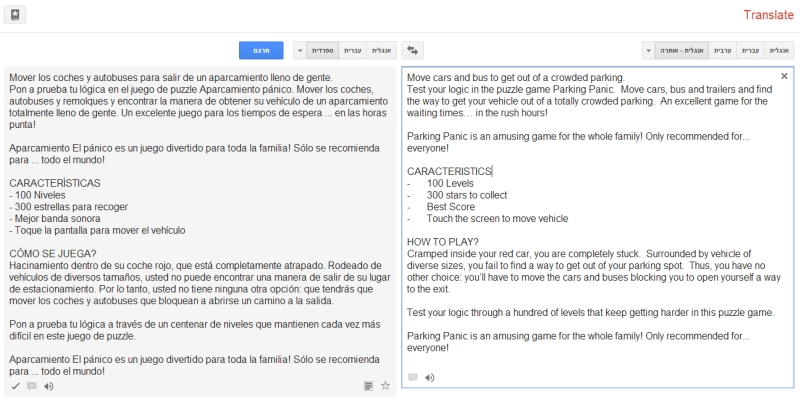
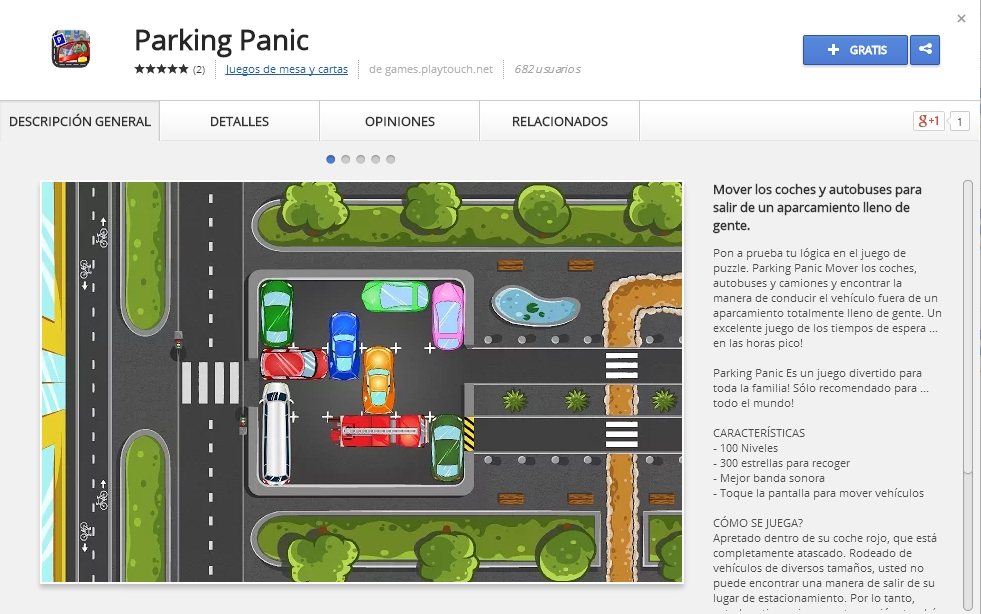
So, I took the original text of one web app, and used Google Translate to compare translations from English to Spanish and from English to Hebrew (You can do so, by clicking on the setting icon in the chrome web store, and changing the language).
languagae settings
The internal tool that Google used in the web store was superior to the public online tool in a few major areas that might concern anyone using automatic translation:
  1. Identifying Names. Google translate mistakenly translated the name of the game I checked (Parking Panic) into the equivalent term (“Aparcamiento pánico” in Spanish, for example). Well, if you are Apple, you don’t want your translated brand be “Manzana” (Spanish for the fruit apple), and I assume this goes for most of us.
  2. Identifying Masculine & Feminine. This is another problem which Google Translate has, but not the internal tool. The Hebrew translation describing the game, said “She is a great game,” while the internal tool identified the game in Hebrew as masculine and described it closer to “it is a great game”
  3. Spelling Mistakes. Microsoft Word found only one mistake in the Hebrew translation of the internal tool vs. two mistakes in the public tool.
  4. Fluency. The internal tool made a few more better decisions than the public tool. When comparing Spanish to Hebrew, it seems that overall, Spanish translation was good even in the public version, but the Hebrew translation was really readable only in the internal tool.
google translate ES
Click to enlarge
chrome web store ES
Click to enlarge.

Why Doesn’t Google Release Its Best Technology If They Have It?

My best bet is that Google is afraid of mass spamming that could be hard to identify. Nevertheless, if they think it is good enough for them to publish it on their Android and Chrome stores, why wouldn’t they allow others to do the same in Google Translate? Knowing Google, you probably are aware that their rules sometimes oblige us, but don’t apply to those located in Mountain View.
If you have other ideas and tests you did yourself on other languages, please share it here.
Opinions expressed in the article are those of the guest author and not necessarily Search Engine Land.

Wednesday, April 30, 2014

4Chan "Hacked" Most Popular Image-Bulletin Board Compromised


The Founder of 4Chan,Christopher Poole aka "moot" has confirmed few hour ago,in a blogspot that the popular image-based bulletin board was hacked.
The attacker gained access to the administrative function and successfully hacked into 4chan database by exploting a website vulnerability last week.The motive behind the hack was to expose the posting habits of fpecific user the attacker didnt like,moot wrote
It is belived that the software vulnerability allowed attacker to hack into only the image board moderation panel,and some table in 4chan back-end database.According to the blog post, the way hacker extracted the information from its database, 4chan know the detail logs of what was accessed,which indicate that the primaly moderator account name and their credential were targeted and compromised bye the hacker.